How Does Trade Finance Work?
A practical business guide explaining how trade finance works, including the step-by-step process, key parties, common instruments, documents, benefits, risks, and business use cases.
Contents
Trade finance helps businesses buy, sell, import, export, and complete commercial transactions with stronger payment security, better cash flow, and reduced risk.
It is widely used by importers, exporters, manufacturers, distributors, commodity traders, contractors, and growing businesses that need secure transaction structures for domestic or international trade.
What Is Trade Finance?
Trade finance refers to financial products and services that support commercial trade transactions between buyers, sellers, banks, suppliers, and logistics providers.
Instead of relying only on trust, trade finance uses banks and financial institutions to provide payment assurance, guarantees, financing, documentation support, and risk protection.
Trade finance helps ensure that sellers get paid, buyers receive goods, and the transaction moves through a clear financial and documentary process.
Why Trade Finance Is Important
Trade transactions often involve timing gaps, shipment risk, payment risk, currency exposure, documentation requirements, and counterparty uncertainty. Trade finance reduces these risks by creating a structured process for payment, delivery, and verification.
- Reduces non-payment risk for sellers.
- Improves buyer and supplier confidence.
- Supports working capital during transaction cycles.
- Helps companies complete larger trade deals.
- Creates a clear document-based process for payment and delivery.
Handling an active trade transaction?
Share your transaction type, amount, timeline, buyer or supplier details, and available documents so the structure can be reviewed properly.
How Trade Finance Works Step by Step
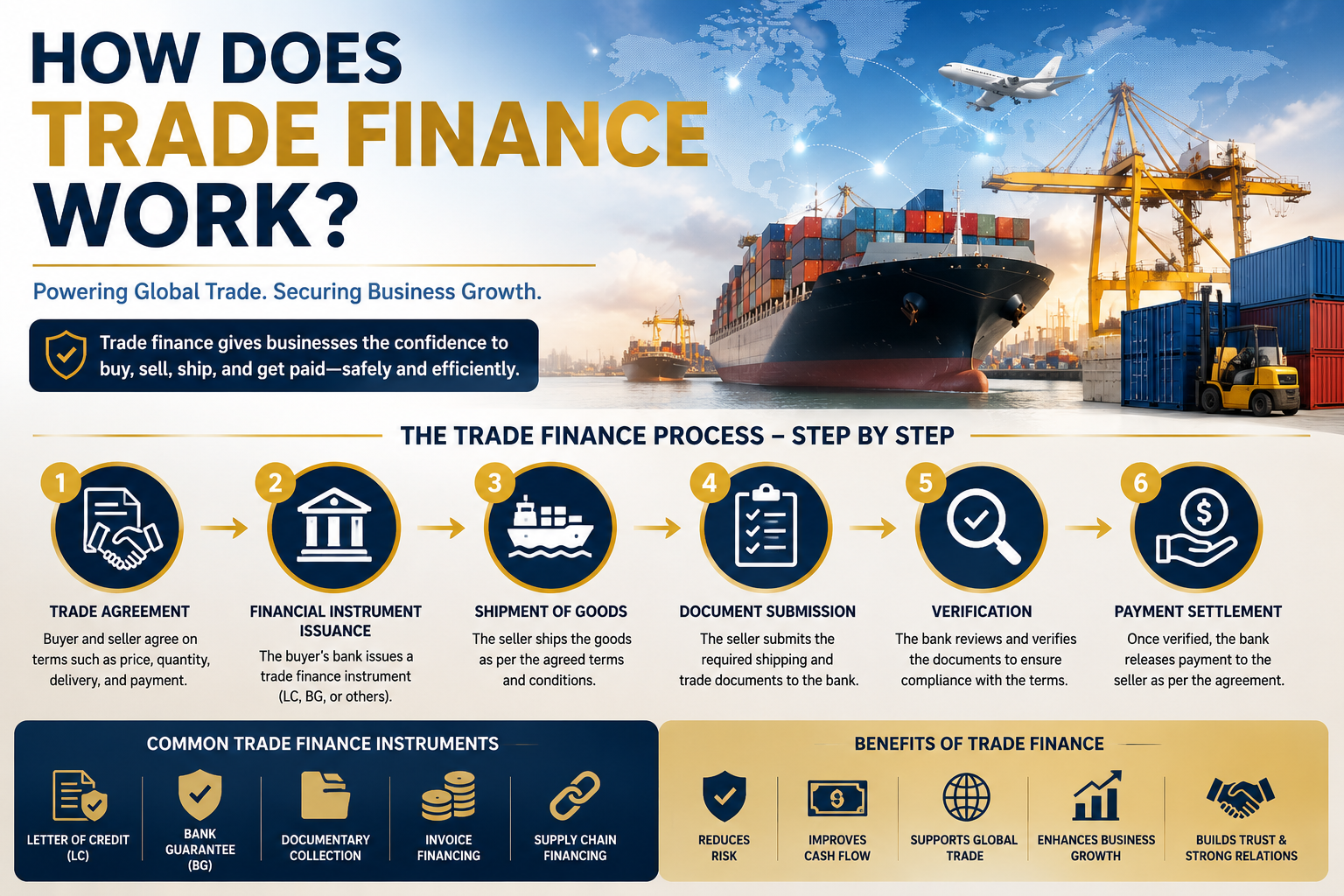
Trade finance usually follows a structured process from commercial agreement to final payment settlement.
Step 1: Buyer and Seller Agree on Terms
The process starts when the buyer and seller agree on the product, quantity, price, delivery terms, payment method, shipment timeline, and required documents.
Step 2: Buyer Requests a Trade Finance Instrument
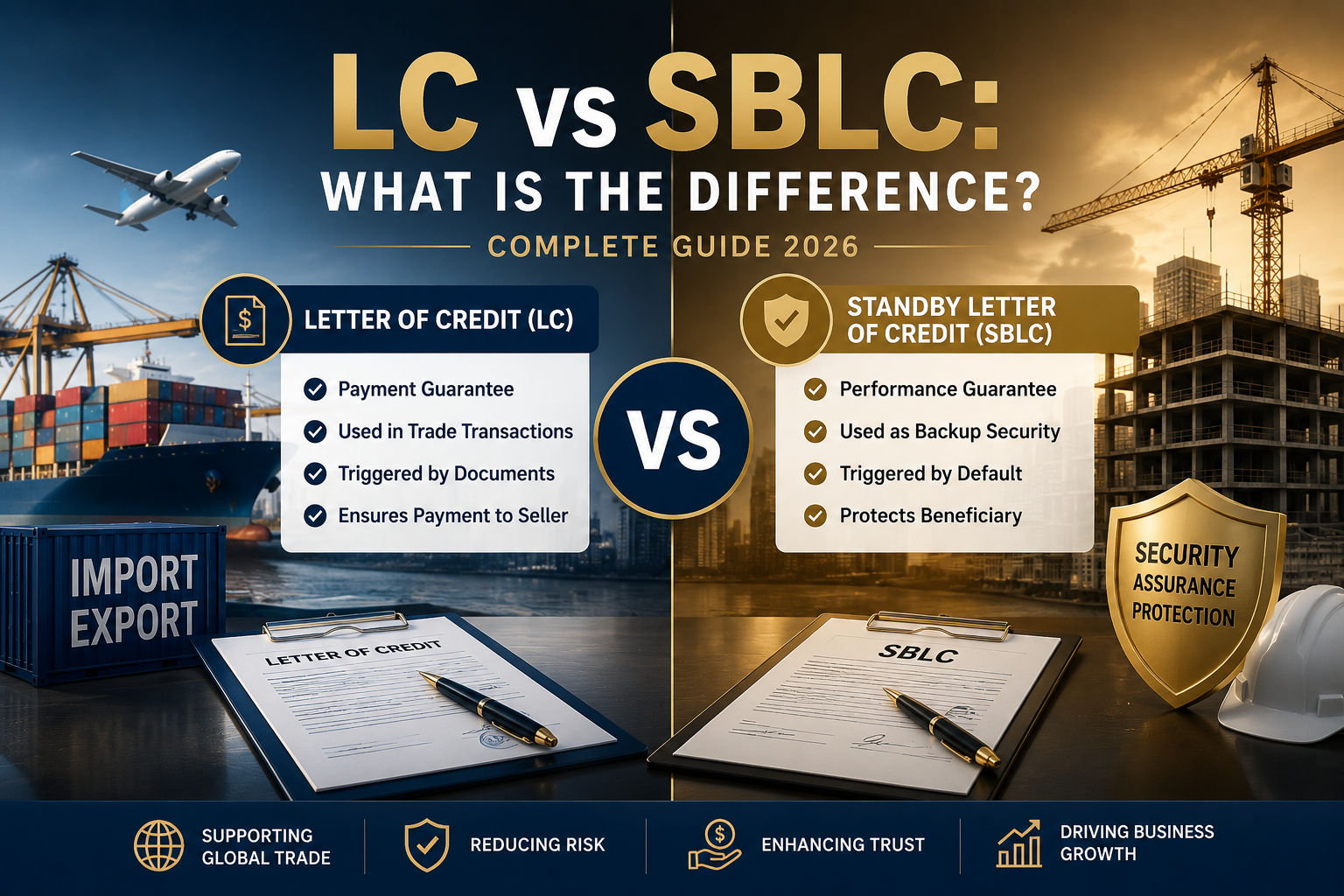
The buyer may request a financial instrument such as a Letter of Credit, SBLC, Bank Guarantee, documentary collection, invoice financing, or supply chain finance solution.
Step 3: The Bank Issues the Instrument
After review and approval, the bank issues the selected instrument. This gives the seller or beneficiary more confidence that payment or performance is financially supported.
Step 4: Seller Ships the Goods
The seller ships the goods according to the agreed contract terms and prepares the required trade documents.
Step 5: Documents Are Submitted and Checked
The seller submits documents to the bank. The bank reviews them to ensure they match the agreed terms and conditions.
Step 6: Payment Is Released
Once the documents are verified, payment is released according to the instrument terms. The buyer receives the documents needed to claim or clear the goods.
Parties Involved in Trade Finance
A trade finance transaction may involve several parties depending on the structure.
- Buyer or importer: The business purchasing the goods or services.
- Seller or exporter: The business supplying the goods or services.
- Issuing bank: The buyer’s bank that issues the trade finance instrument.
- Advising bank: The seller’s bank that advises the instrument.
- Confirming bank: An optional bank that adds payment assurance.
- Logistics provider: The party responsible for transportation and shipment.
- Insurance provider: The party supporting shipment or transaction risk coverage.
Common Trade Finance Instruments
Different instruments are used depending on the transaction purpose, risk level, payment terms, and business requirement.
| Instrument | Purpose | Common Use |
|---|---|---|
| Letter of Credit (LC) | Payment assurance against compliant documents | Import and export transactions |
| Standby Letter of Credit (SBLC) | Backup security if default occurs | Large contracts and financial assurance |
| Bank Guarantee (BG) | Guarantees contractual obligations | Projects, tenders, suppliers, and contractors |
| Documentary Collection | Bank-assisted document exchange | Trusted buyer-seller relationships |
| Invoice Financing | Liquidity against unpaid invoices | Working capital and receivable support |
| Supply Chain Finance | Early supplier payment with buyer payment terms | Supplier networks and large buyers |
Documents Commonly Needed
The exact documents depend on the transaction and instrument, but common trade finance documents include:
- Commercial invoice
- Purchase order or sales contract
- Bill of lading or airway bill
- Packing list
- Certificate of origin
- Insurance certificate
- Inspection certificate
- Buyer, seller, and beneficiary details
- Bank statements or financial records where applicable
Benefits of Trade Finance
- Improves cash flow: Businesses can continue operations while waiting for payment or delivery cycles.
- Reduces risk: Banks and financial instruments create stronger transaction protection.
- Supports global trade: Companies can work with overseas buyers and suppliers more confidently.
- Builds trust: Trade finance improves credibility between counterparties.
- Enables growth: Businesses can handle larger orders and expand into new markets.
Industries That Use Trade Finance
Trade finance is used across many sectors where payment security, delivery timing, and working capital are important.
- Manufacturing
- Commodity trading
- Construction and contracting
- Retail and distribution
- Agriculture and food exports
- Electronics and technology
- Logistics and supply chain businesses
Risks and Challenges in Trade Finance
Trade finance reduces risk, but businesses still need proper structuring and documentation. Common challenges include document discrepancies, currency fluctuations, compliance requirements, political risk, country risk, and fraud risk.
Small document errors can delay payment. Before submitting documents, businesses should check names, dates, quantities, shipment details, invoice values, and instrument terms carefully.
Trade Finance vs Traditional Business Loan
Trade finance is usually linked to a specific transaction, shipment, invoice, contract, or payment obligation. A traditional business loan is broader funding and may not include transaction protection.
| Feature | Trade Finance | Traditional Business Loan |
|---|---|---|
| Purpose | Supports trade transactions | General business funding |
| Structure | Transaction-based | Loan-based |
| Risk Protection | Often includes payment or performance support | Usually limited |
| Best For | Import, export, receivables, supplier transactions | General working capital or expansion |
How to Choose the Right Trade Finance Solution
The right solution depends on the transaction amount, buyer reliability, supplier relationship, payment terms, contract structure, delivery timeline, country risk, and available documents.
A proper review helps identify whether the business needs an LC, SBLC, BG, invoice financing, supply chain finance, or another structured finance solution.
Conclusion
Trade finance works by connecting buyers, sellers, banks, documents, and payment structures into one organized transaction process. It helps businesses reduce risk, improve cash flow, and trade with greater confidence.
Whether the requirement involves importing goods, exporting products, securing supplier payment, supporting a contract, or managing receivables, trade finance can provide the structure needed to move the transaction forward.

Reviewed by National Finance Insights
National Finance publishes practical finance guides for businesses covering trade finance, Letters of Credit, SBLC, Bank Guarantees, corporate funding, structured finance, and transaction readiness.
Trade Finance Process FAQs
Common questions businesses ask about how trade finance works.
How does trade finance work?
Trade finance works by using banks, financial institutions, documents, and financial instruments to support payment, delivery, and risk protection between buyers and sellers.
Who uses trade finance?
Importers, exporters, manufacturers, distributors, suppliers, contractors, commodity traders, and SMEs commonly use trade finance for secure transactions and working capital support.
What are common trade finance instruments?
Common instruments include Letters of Credit, Standby Letters of Credit, Bank Guarantees, documentary collections, invoice financing, and supply chain finance.
Is trade finance the same as a business loan?
No. Trade finance is usually connected to a specific transaction, shipment, invoice, or contract, while a business loan is broader funding with a repayment schedule.
What documents are needed for trade finance?
Common documents include invoices, contracts, purchase orders, bill of lading, packing list, certificate of origin, insurance certificate, and buyer or seller details.
Related finance topics
Continue reading practical guides connected to trade finance, banking instruments, and structured finance.
Need trade finance support for your transaction?
If your business is handling an active requirement involving import, export, supplier payment, LC, BG, SBLC, invoice financing, or working capital support, National Finance can review the structure and guide the next step.